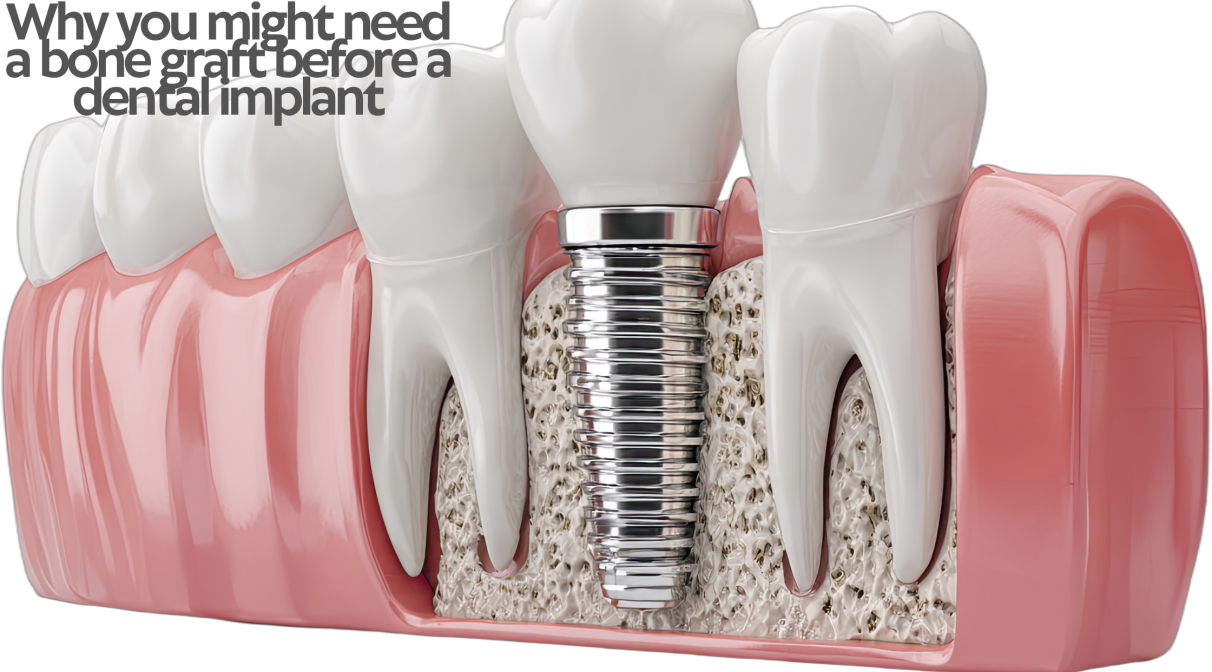
Why you might need a bone graft before a dental implant
You’ve lost a tooth, you’ve decided a dental implant could be the right option, and then you hear three words you weren’t expecting:
“You may need a bone graft.”
It can sound like an extra procedure you could really do without. But a bone graft isn’t necessarily a sign that something has gone wrong. In many cases, it is simply about making sure there is enough healthy bone to support your new dental implant properly.
If you’re considering dental implants in Colchester, here’s what you need to know.
Why does bone matter for a dental implant?
A dental implant replaces the root of a missing tooth. It is placed directly into the jawbone, where it needs to become firmly integrated with the surrounding bone.
Think of it like building a house.
You wouldn’t build a house on ground that wasn’t strong enough to support it. An implant needs a stable foundation too.
When a tooth has been missing for some time, the bone that once supported its root can gradually shrink. This is completely natural. Your body no longer has a tooth root stimulating the bone, so there is less reason for that bone to remain at the same volume.
The result can be a jawbone that is too narrow, too shallow or simply not dense enough to support an implant in the ideal position.
That’s where a bone graft may come in.
Why might you have lost bone?
There are several reasons why you may not have enough bone for an implant straight away.
A tooth has been missing for a while
Bone naturally changes after a tooth is removed. The longer a tooth has been missing, the more bone loss can occur in some people.
You’ve had a tooth removed
Sometimes bone loss happens following an extraction. The amount varies from person to person and can depend on the condition of the tooth, the surrounding bone and how the area heals.
Gum disease has affected the bone
Advanced gum disease can cause the bone supporting your teeth to be lost. If this has happened around a missing tooth, there may not be enough bone available for an implant without aditional treatment.
Your natural anatomy
Sometimes it’s simply the shape of your jaw.
This is particularly relevant in the upper jaw, where the sinuses can sit close to the area where an implant needs to be placed. Your dentist may therefore recommend a particular type of bone augmentation to create enough space and support.
So, what actually is a bone graft?
A bone graft is a procedure used to add or encourage new bone in an area where there isn’t currently enough.
There are different types of grafting materials and techniques, depending on your individual situation.
Your dentist will assess the amount and quality of bone you have before recommending the most appropriate approach.
The aim is straightforward:
Create a strong, stable foundation for your implant.
It isn’t about making your jawbone bigger for the sake of it. It’s about creating the conditions needed for an implant to be placed safely and in the right position.
Does everyone having an implant need a bone graft?
No.
Many people have enough healthy bone for an implant to be placed without a graft.
This is why the assessment stage is so important.
Your dentist may use detailed imaging, such as a 3D scan, to assess the bone available and plan where the implant should ideally be positioned.
Importantly, it’s not simply a case of asking, “Can we fit an implant here?”
The better question is:
“Can we place the implant in the right position, with enough healthy bone around it to support it properly?”
Sometimes the answer is yes.
Sometimes a bone graft is the step that makes the answer yes.
Does a bone graft mean my implant treatment will take longer?
Potentially, yes.
Depending on the type and extent of grafting required, there may need to be a period of healing before the implant can be placed.
We know that waiting isn’t always the most exciting part of dental treatment. But when it comes to implants, rushing the foundations isn’t the goal.
Good implant planning is about getting the biology, position and stability right rather than simply getting the tooth replaced as quickly as possible.
Your dentist will explain what is recommended for your particular case and how the stages fit together.
What happens if you don’t have a bone graft?
If there isn’t enough bone to safely support an implant in the ideal position, placing one without addressing the problem may not be appropriate.
Your dentist may discuss other options with you, depending on your individual circumstances.
The important thing is that there isn’t a one-size-fits-all implant plan.
Your treatment should be based on your mouth, your bone, your health and what you want to achieve.
Thinking about dental implants in Colchester?
If you have a missing tooth and are considering dental implants in Colchester, a proper assessment is the place to start.
You may have plenty of bone and be ready to discuss implant placement.
Or you may need some additional preparation first.
Neither means your implant journey has to stop.
Sometimes, the best way to get a long-lasting result is to take a little more time getting the foundations right.
Want to find out whether a dental implant could be suitable for you?
At Hello Dental, we offer implant consultations where we can assess your individual situation, talk through your options and explain what would be involved.
No pressure. No confusing jargon. Just a clear conversation about what comes next. Find out more:https://hellodental.co.uk/treatment/dental-implants/
Ready to talk implants? Get in touch with Hello Dental in Colchester to arrange your consultation.
Back to Blog